
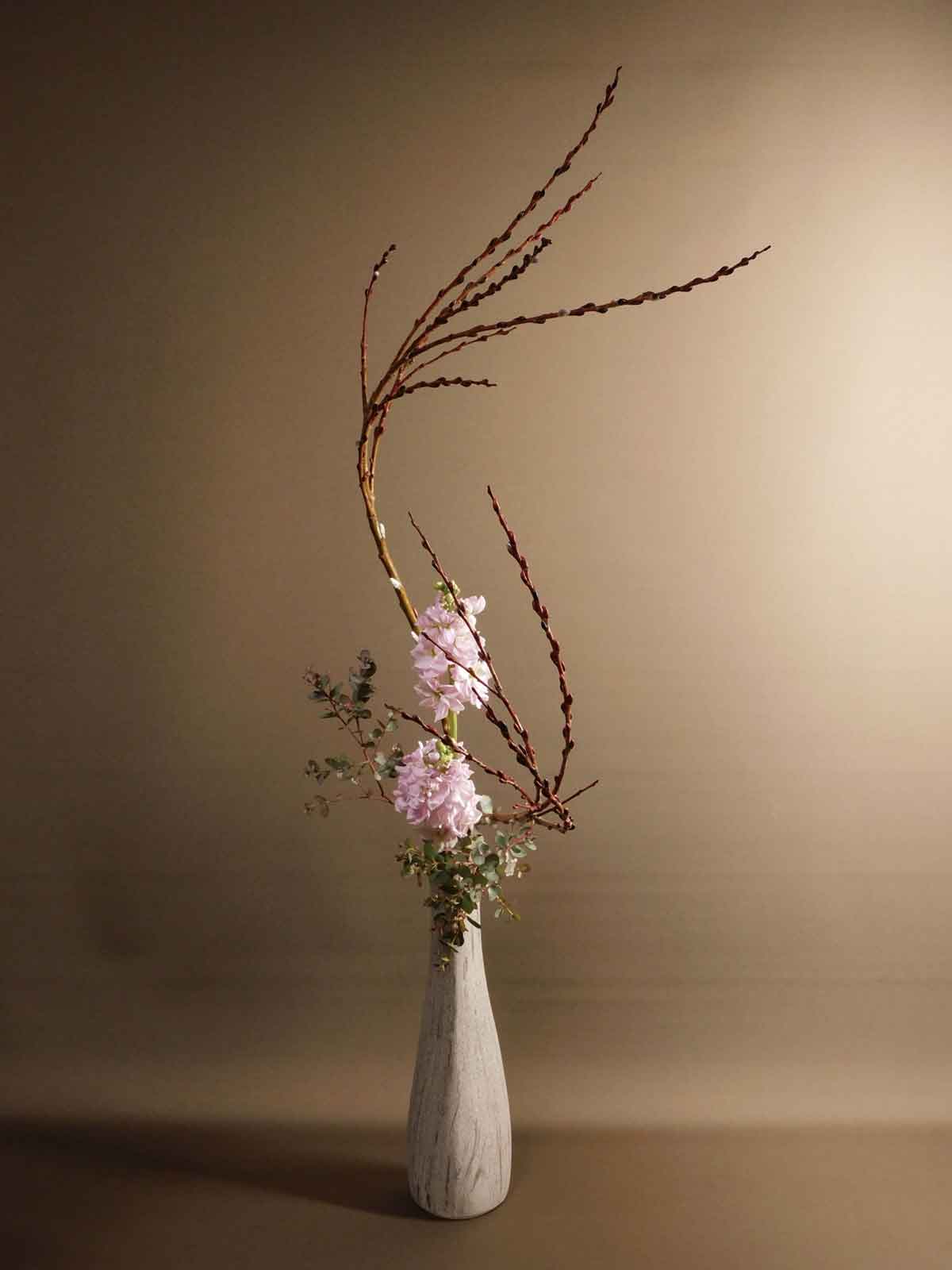
Kado is a Japanese traditional culture in which seasonal flowers and plants are arranged in vessels to enjoy the beauty of the flowers and the space they create. Some people may not be able to start because of the image that it is difficult to learn without proper etiquette and sense of style.
Kado can be enjoyed in daily life as long as you learn the basics, although the content of what you learn differs depending on which style of kado you choose. In this article, we will introduce the history of kado, the necessary tools, and the basic knowledge of the major styles for those who are learning for the first time.
What is kado?
Kado is a traditional art form that allows both those who arrange flowers and those who appreciate them to fully enjoy seasonal Japanese flowers and plants. Recently, it is increasingly used in agreement with hanamichi and ikebana. In kado, it is believed that plants and flowers, like people, have lives of their own. The appeal of ikebana is that it allows one to enjoy the process of creating a work of art while considering how to beautifully express the charm of each flower and space with a limited amount of flowers, and how to combine them with a sense of the season.
This is a way to enjoy flowers in contrast to dried flowers, which fill a space with many flowers and enjoy their gorgeous appearance. Kado was created in the mid Muromachi period (1336-1573). It is said to have begun as an offering of flowers and plants to the Buddha. At that time, there were several detailed rules and regulations, which were different from those of modern kado. After the middle of the Edo period (1603-1867), ikebana became popular as an easy way to start ikebana, and it continues to evolve even today.
This is a way to enjoy flowers in contrast to dried flowers, which fill a space with many flowers and enjoy their gorgeous appearance. Kado was created in the mid Muromachi period (1336-1573). It is said to have begun as an offering of flowers and plants to the Buddha. At that time, there were several detailed rules and regulations, which were different from those of modern kado. After the middle of the Edo period (1603-1867), ikebana became popular as an easy way to start ikebana, and it continues to evolve even today.
Tools Used in Kado
 There are several tools needed to enjoy kado. Let us look at the basic tools used in flower arrangement.
Flower scissors
Flower scissors(hana basami There are steel and stainless steel scissors, so choose the one that is easy to use in your hand. Steel scissors are susceptible to moisture and rust easily, so they must be maintained by wiping them clean after use and sharpening them regularly. If you find maintenance a hassle, choose stainless steel flower scissors.
Flower clasps
Flower clasps(hana dome They are called kenzan or cloisonne and are characterized by a number of needles on the metal fittings. If you are new to this, you should choose one that is the right size for the size of the vase you will be using and that has a non-slip surface. If you go to a specialty store, the nonslip is sold as a single item. For home enjoyment, marbles or sponges can be substituted for flower clasps.
Vase
Vases come in a wide variety of designs and sizes, so choose one while thinking about how you want to arrange the flowers. For beginners, it is better to choose a vase with a simple design and not too large. A vase with an eccentric design is more difficult because you need to consider the balance between the flowers and the vase. If you enjoy flower arrangement at home, you can try using a container such as a cup.
Where to buy tools used in kado
It is best to buy the tools used in kado by consulting the staff of a specialty store or, if you plan to start practicing, the teacher of a kado class. Some large florist shops and home centers may sell tools, but they may not carry specialized items such as flower clasps made of materials that are resistant to rust or flower clasps with non-slip fasteners.
Typical Flower Arrangement Style
 Although there are many different styles of kado, the basic techniques for arranging flowers and plants are the same. Let's take a look at some of the most common procedures for arranging flowers.
- 1. Create a framework by arranging the main materials (three branches).
- 2. Create the atmosphere of the space by arranging two flowers.
- 3. Insert the arrangement (flowers to be arranged) to create a contrast in color.
- 4. Add greenery with a twist to set the overall atmosphere.
Points to keep mind when arranging flowers
Flowers are arranged facing the viewer. Since kado is all about making ikebana look beautiful, place large leaves and grasses low to the ground to better hide artificial objects such as wires and kenzans. Also, if a branch is repeatedly inserted into a kenzan, the base of the branch will become soft and difficult to insert. Cut the base of the flower at an angle with flower scissors to make it easier to insert.
Typical Styles
 It is thought that there are about 2,000~3,000 styles of kado. The most representative schools are Ikenobo, Sogetsu style, and Ohara Style, which are also known as the three major styles. Let us take a look at the characteristics of each style.
Ikenobo
Ikenobo is the head of the school that created kado. For this reason, it is not referred to as a school like other styles. There are three types of flower arrangement: rikka, shoka, and free style. For those who are new to kado, it is best to start with free style ikebana, which allows for a certain degree of freedom and enjoyment. Rikka and shoka are more traditional and there are many things to learn, so it is recommended to learn them after you are familiar with them.
Sogetsu style
The Sogetsu style has no rules and is a unified style that allows one to enjoy kado in an artistic way. It is characterized by its many unique works, some of which are made of wood without flowers and some of which are made of metal instead of ikebana. Beginners learn kata through basic Tateshina and basic tilt shin kata, and then create their own works of art with free ideas. This will be comfortable for those who want to enjoy kado without being bound by tradition or rules.
Ohara Style
Ohara Style was created in the mid Meiji period and is a traditional style that actively uses Western flowers. There are four types of flower arrangement: moribana, hana design, vase flower arrangement, and hanamai. Among them, moribana, which expresses beauty by arranging flowers in a wide mouthed container, allows the view of the water basin as well as the flowers to be enjoyed in a beautiful way. It is said that moribana influenced many styles of flower arrangement at that time. You will not only enjoy kado, but also learn how to arrange flowers in a way that you can use in your daily life.
Let's incorporate kado into our daily lives!
 Kado is a Japanese traditional art form that allows you to enjoy the beauty of lines and space created by using seasonal flowers and plants. It is not a formal art, and anyone can easily incorporate it into their daily lives once they have learned the basics. If you are at all curious about ikebana, why not start by arranging flowers in a cup or glass container that you have at home?
Kado is a Japanese traditional art form that allows you to enjoy the beauty of lines and space created by using seasonal flowers and plants. It is not a formal art, and anyone can easily incorporate it into their daily lives once they have learned the basics. If you are at all curious about ikebana, why not start by arranging flowers in a cup or glass container that you have at home?