
Japanese Cedar Incense Made Without Electricity: Inside the Baba Water Mill
There's a particular kind of quiet you only find deep in the mountains. In Yame, a mountain town in Fukuoka Prefecture, better known for its tea, that quiet is broken by one sound only: a river turning a wheel, a form it has taken for more than a hundred years.
This is where Baba Water Mill Incense comes from. It's a small story, but it's worth telling accurately.
A Wheel That Still Turns

The mill itself dates back to 1918, built with money pooled together by families in the Yaetani hamlet. In 1961, Baba Jirō bought the land and put the wheel to work grinding Sugi (Japanese cedar) into incense powder.
The wheel you'd see today isn't the original, though. A wooden wheel this size lasts about 25 years before it has to be rebuilt, and this one most recently was, in 2008. That's the actual tradition here. Not one wheel lasting a century, but a family rebuilding it, generation after generation, because the alternative was letting the whole process disappear.
What hasn't changed is the scale of it: a 5.5-meter wooden wheel drives 15 wooden pestles, each weighing around 60 kilograms, pounding dried sugi leaves into a fine powder over a full day.
At the height of the industry, more than 40 workshops in the Yame area processed Sugi into incense powder this way. Cheaper imported powder pushed most of them out, and today only a handful remain. Baba Water Mill is thought to be the last in Yame to use a waterwheel.

Baba Takeshi and Chieko, "The Forest's Cleaners"
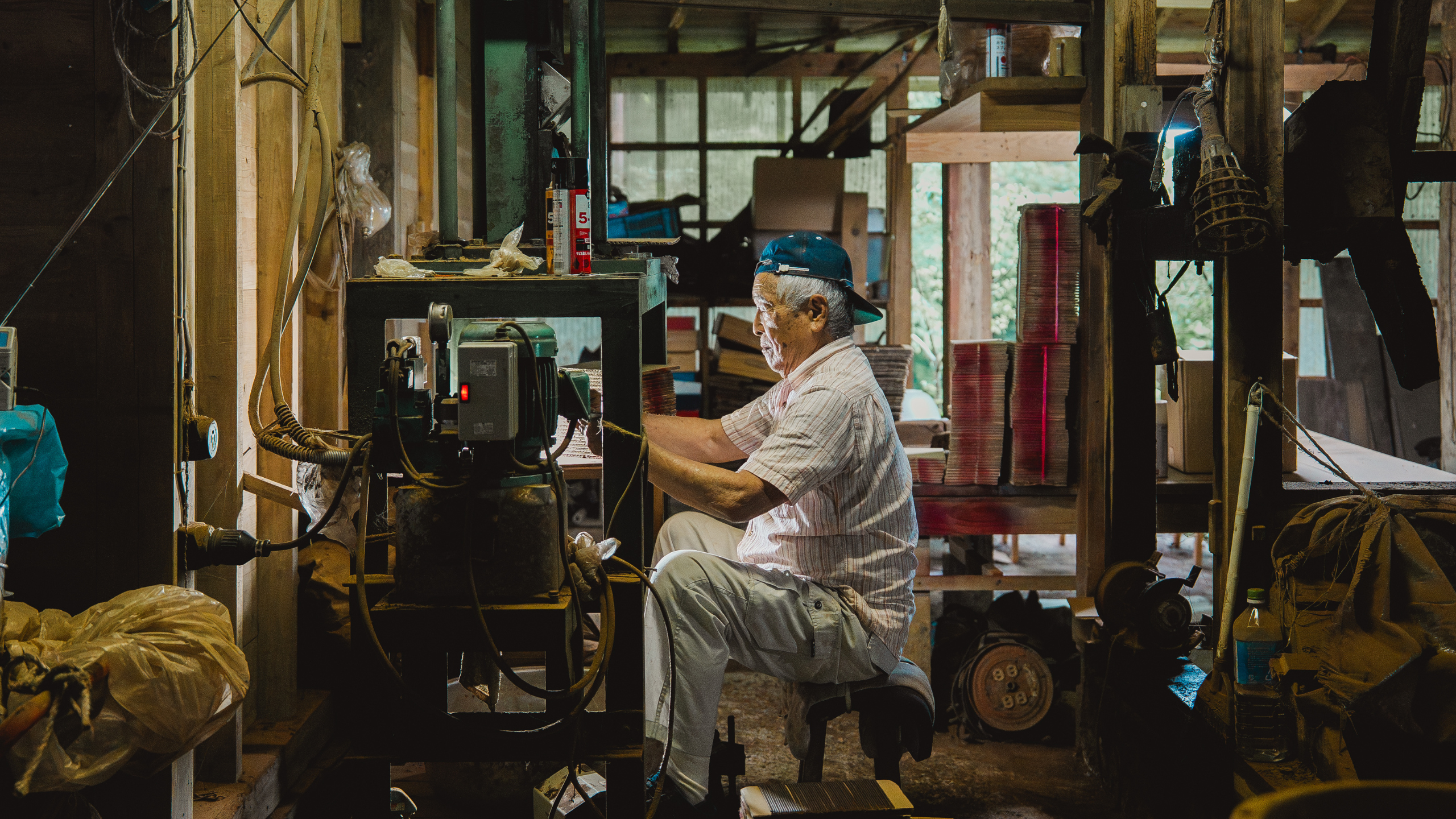
The mill belongs to Baba Takeshi and his wife, Chieko, who still tend it by hand the same way it's always been tended. Takeshi calls himself "the forest's cleaner," and his days follow the mountain's own calendar. Wild vegetables in spring, sweet fish from the river in summer, wild yams dug from the hillside in autumn, and hunting once winter sets in.
"As long as my body can move," he told us, "I'll carry this on."
It's a simple line, but it stays with you. Every stick of incense that leaves this mill carries a little of that resolve.

Two Ingredients - and Why That's Enough
Sugi leaves are naturally rich in aromatic oils, which means they burn well on their own — no synthetic combustion aid needed, unlike many commercial incenses. To bind the powder into a stick, the mill adds Tabunoki (Machilus thunbergii) leaves and bark, which are naturally sticky and hold everything together without any synthetic binder.
That's the whole recipe: Sugi leaves and Tabunoki, both gathered locally. No synthetic fragrance, dyes, binders, or anti-mold agents are added.

Customers who usually find incense harsh on the throat have told us this one feels different and lighter, and less like standing in a cloud of perfume. Light it, and the room smells like a sugi forest after rain.
The sugi branches used here aren't lumber grade, so they have little other market value. In a sense, the mill turns material that would otherwise go unused into something worth keeping.

Pairing It with Tatami
Sugi carries its own natural aromatic oils. Igusa, the rush grass in IKEHIKO tatami, carries vanillin, the compound behind its faint, sweet scent. Neither is unique to relaxation on its own. But in Japan, both scents are closely associated with the calm of standing in a forest, which is part of why the pairing works.
We like to light a stick of this incense beside an IKEHIKO Tatami Yoga Mat or Rush Grass Rug. The grassy warmth of the igusa and the woodsmoke of the cedar settle into each other, and for a few minutes, a living room can feel a lot like standing among trees. It doesn't take much to unroll the mat, light the stick, breathe.
Light it after your evening shower, roll out the mat, and give yourself ten minutes before the day catches up with you again.

A Small, Slow Choice
Buying incense made this way by one family, one wheel rebuilt generation after generation. It is a quiet vote against everything mass-produced. It won't rebuild the industry that Yame used to have, but it keeps one part of it going.
Each bundle holds 60 sticks (30g), hand-cut and tied by the Baba family themselves.
There's only one waterwheel, one family - this isn't something that scales.

FAQ
What is Baba Water Mill incense made from?
Just two things.
Dried Sugi (Japanese cedar) leaves and Tabunoki (Machilus thunbergii) leaves and bark, ground into incense by a water-powered mill in Yame, Fukuoka.
What's actually in Baba Water Mill incense?
No synthetic fragrance, dyes, binders, or anti-mold agents. Just Sugi leaves and Tabunoki, both gathered locally and ground by the mill's own waterwheel.
Why doesn't this incense need a synthetic binder?
Sugi leaves are naturally rich in aromatic oils and burn well on their own. Tabunoki leaves and bark are naturally sticky, so mixed into the powder, they bind the sticks together without any added chemical binder.
How is the incense made without electricity?
A 5.5-meter wooden waterwheel, turned by the river alone, drives 15 wooden pestles (about 60kg each) that pound dried sugi leaves into a fine powder over roughly a day. The mill dates to 1918; the wheel itself is rebuilt roughly every 25 years, most recently in 2008.
What does Baba Water Mill incense smell like?
Soft and woody, closer to a Sugi (Japanese cedar) forest after rain than to a typical store-bought incense.
How do I use incense and tatami together for a relaxation ritual?
Light a stick near an IKEHIKO tatami mat or yoga mat. Sugi's natural oils and igusa's vanillin are both traditionally linked to relaxation in Japan, so together they build a layered, forest-like atmosphere for meditation, yoga, or simply winding down.
![[ Sado, a Traditional Art ] Is there a qualification for Sado? What do you mean by licensed? Traditional Culture, Sado](http://www.ikehikojapan.com/cdn/shop/articles/romeo-a-lscGvpiDBLA-unsplash.jpg?v=1667461466&width=1920)